
Camera gear guides
Build a Camera Kit That Fits the Way You Shoot
Start with the task, then choose the equipment that fits it. A day bag, a desk support and an on-camera microphone solve different problems; buying by a single headline specification can leave the complete setup awkward or incompatible.
Our camera-gear comparisons separate listing specifications, customer-reported experience and unresolved details. They are research-based guides, not hands-on shooting tests. Compatibility belongs to an exact combination of parts, and a maker's load, output or runtime claim is not our independent measurement.
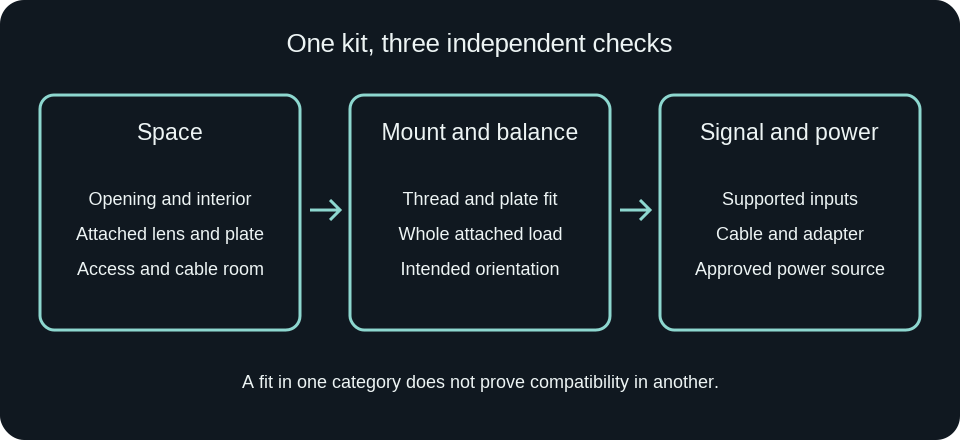
First, describe the setup
Write down the camera and lens, the photograph or video you want to make, where the equipment will be used and how it will travel. Include the parts that remain attached: plate, microphone, monitor, cable or light. That list makes missing space, mounting and power requirements easier to find before buying.
Read Plan a Camera Kit Around Fit, Support and Power for a complete pre-purchase checklist, and Lens Mounts, Focal Length and Stabilization before assuming a lens or adapter provides every required function.
Support: size is not stability
For a travel tripod, compare folded length and carried mass with the bag space available. Then check working height, controls and the intended camera/lens balance. A load rating does not establish vibration performance. A tabletop setup adds desk footprint, cable clearance and access to camera controls. A monopod requires active support; small auxiliary feet do not automatically make it a freestanding tripod.
Explore travel tripods, tabletop tripods and monopods.
Carry: measure the assembled kit
A camera pack's capacity number does not tell you whether an attached lens passes through the opening. Compare usable interior dimensions, divider positions and access with the actual kit. A small sling may be useful for a deliberately limited load; it is not a substitute for checking the strap arrangement and how the bag opens while worn. With a camera strap, the exact anchor and lug system matters more than a broad brand-compatibility label.
Compare day-trip backpacks, small-kit sling bags and everyday camera straps.
Lighting: trace the conditions behind the claim
Check the included power supply, mounting arrangement and modifiers before treating a light as a complete kit. Published output and runtime figures apply to their stated conditions. They do not establish our measured brightness, color accuracy or runtime in another setup. Leave the ventilation and clearance specified by the maker.
Explore LED panels for desk photography and portable lights for small scenes.
Video audio: follow the connection
A familiar plug shape is not enough. Check microphone output, camera input, required cable and power at both ends. A phone adapter or recording interface may be a separate requirement; do not assume it is included or that one cable supports every device.
Read on-camera microphones for video with the exact camera instructions beside you.
Care: identify the permitted surface
Choose cleaning tools for the surface the maker permits them to touch. A kit title does not establish sensor-cleaning suitability. Keep external-surface work separate from any procedure requiring different tools, instructions or service.
Use camera cleaning kits for external surfaces as a starting point for that distinction.
A final buying checklist
- What specific task does the accessory solve?
- Is the exact camera/lens/accessory combination supported?
- Do dimensions, openings and controls fit the complete setup?
- Are mounting, balance, signal and power checked separately?
- Which components are included, and which are optional?
- Which claims are manufacturer/listing specifications rather than measured results?
- What unresolved limitation would change the decision?
Choose around the answer to those questions, not the largest number on the box.
Compare camera gear by task
Camera Backpacks for Day Trips
Choose a camera backpack around the kit you carry and the space left for the rest of the day. Internal dimensions, access openings and divider positions matter more than an isolated capacity number. A bag that fits a body with its lens detached may not fit the…
Camera Cleaning Kits for External Surfaces
Choose cleaning tools for the exact surface the camera, lens and tool makers permit them to touch. A kit name does not establish that every brush, pen, tissue or liquid is suitable for every coating. This comparison is limited to external surfaces; it is not a…
Camera Sling Bags for Small Kits
A small sling works best when you deliberately limit the kit. Start with the camera and attached lens, then add the batteries, cards and accessories that really need to travel. A capacity label does not establish that the ready-to-shoot camera passes through the…
Camera Straps for Everyday Carry
Choose a camera strap by its exact attachment system and the way you want the camera to sit. Two strap eyelets and a bottom-mounted sling fastener are different setups. A familiar camera brand in a listing does not establish that the connectors fit your lugs, that a…
LED Panels for Desk Photography
Choose a desk light around the space, power source and mounting arrangement you will actually use. Panel size, brightness controls and the included stand solve different problems; a published output figure is meaningful only with its stated measurement distance and…
Monopods for Mobile Camera Support
A monopod can support part of a camera's weight while you keep control of its position. It is not a freestanding substitute for a tripod. Choose the deployed height, packed size, mounting arrangement and foot configuration for the way you will hold and move the…
On-Camera Microphones for Video
Start with the camera's microphone input and power support, then choose the microphone and cable. A matching plug shape does not establish the right signal, wiring or operating power. A microphone mounted on a camera also remains at the camera's distance from the…
Portable LED Lights for Small Scenes
A small camera light is useful only if its mounting, power and controls fit the scene. Start with the space around the subject and the support available. A pocket-size panel is not automatically a replacement for a larger key light, and a battery-capacity number…
Tabletop Tripods for Desk Setups
A tabletop tripod needs enough working height for your framing and enough clearance for the whole camera setup. Start with the desk space, camera mounting point and lens position, not the largest advertised load rating. A heavy camera can still be awkward on a small…
Travel Tripods for Camera Carry
A tripod that fits your bag is more likely to leave home with you. Start with folded length and carried mass, then check working height, controls and the camera-and-lens combination you actually intend to mount. A large advertised load rating does not establish…
Build the foundations
Plan a Camera Kit Around Fit, Support and Power
A useful camera kit is a set of compatible parts, not a collection of impressive specifications. Start with the photograph or video you want to make, then check the space, mounting and connections needed to make that setup work. Carry capacity, physical fit and…
Lens Mounts, Focal Length and Stabilization
Start with the exact camera and lens, not a familiar brand name. Physical attachment, electronic operation and image coverage are separate compatibility checks. Stabilization adds another system-specific question; it is not a promise that every photograph will be sharp.